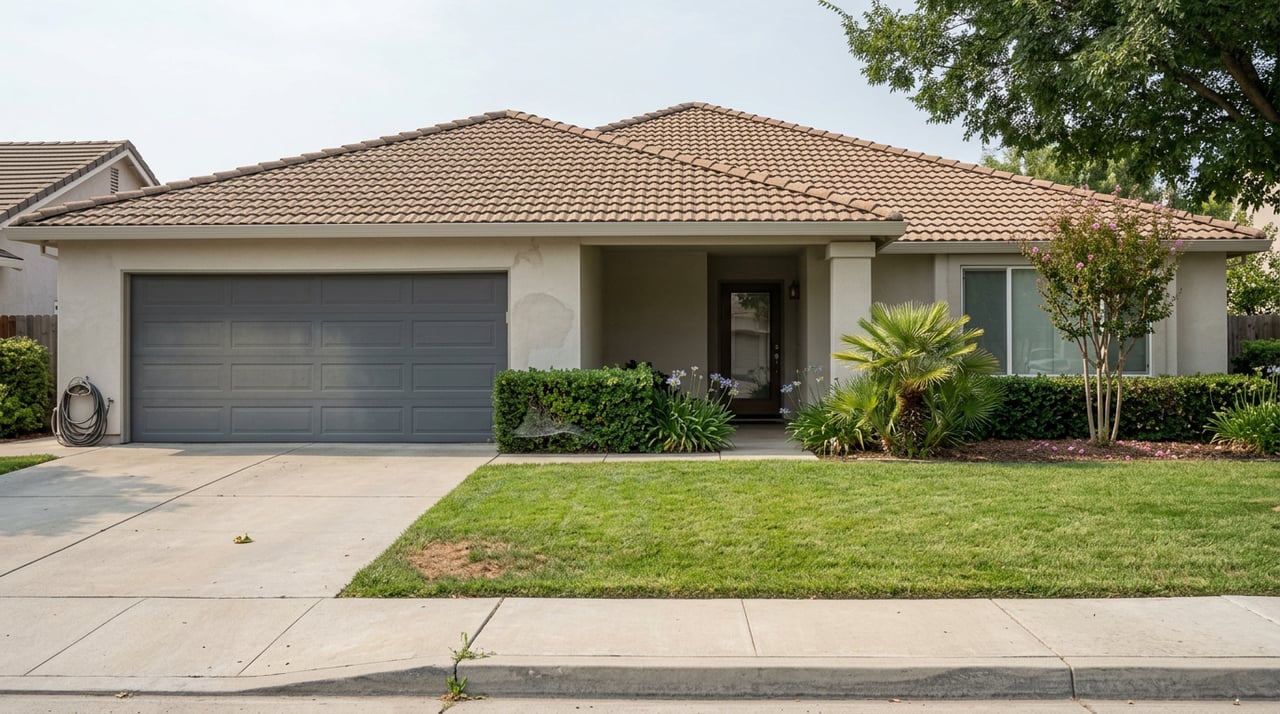
Drive along North La Palma Parkway near Swan Street and something that used to look like a leftover strip of city right-of-way now looks intentional. Angled parking. Six new crosswalks. Rows of shade trees still thin enough to see the trunks. If you have lived in this stretch of Anaheim for a while, you probably clocked the construction crews sometime in late 2024 and mostly forgot about them once the cones disappeared.
That would be a mistake. The street conversion outside La Palma Park is only the visible edge of something larger, and it happened within days of a second, unrelated park rebuild a few minutes away near City Hall. Nobody has put these two projects side by side before, because on paper they have nothing to do with each other: different departments, different funding sources, different ribbon-cuttings. Once you look at them together, the shape of what the city has actually been doing to this part of Anaheim gets a lot clearer.
A park older than the freeway next to it
La Palma Park doesn't look like a place with a backstory. It's 21 acres along Harbor Boulevard in north Anaheim, and most people register it as playing fields and a parking lot on the way to somewhere else. It opened in 1939, built with Works Progress Administration funding on what had been an auto scrap yard, which makes it Anaheim's second-oldest park after Pearson Park.
The stadium inside it, Glover Stadium, is named for Richard Glover, who coached Anaheim High School football there from 1931 to 1957. Before that connection to prep football took hold, the same field hosted a Pacific Coast League spring training game between the Seattle Rainiers and Sacramento Senators, then 1940 spring training for the Philadelphia Athletics and 1946 spring training for the St. Louis Browns, the franchises now known as the Oakland Athletics and Baltimore Orioles. Joe DiMaggio played there during World War II as part of the Santa Ana Air Base team. In 1950, part of "The Jackie Robinson Story" was filmed on the same field. La Palma Park also holds the distinction of being Anaheim's first dog park.
None of that history shows up on a sign at the entrance. It shows up in city documents and a scattering of local write-ups, which is exactly why most residents drive past Glover Stadium without knowing what they're passing.
The $4 million street that stopped being a through-street
The visible project, the one you can actually walk on today, is the North La Palma Parkway and Swan Street conversion. The city broke ground on September 17, 2024, turning what had been a conventional two-way through-street into a one-way, tree-lined promenade meant to function as an actual entrance to the park rather than a route past it.
The finished numbers, drawn from the city's own announcement: more than 200,000 square feet of new roadway paving, six new crosswalks, 30 stormwater planters, 48 new shade trees, and more than 500 drought-tolerant plants along the corridor. The Swan Street side added angled parking and electrical hookups for food trucks. The project cost $4 million, funded through a $2.6 million grant from Caltrans's Clean California initiative, a statewide $1.2 billion, multiyear cleanup effort, plus a $1.4 million match from the city. Caltrans held a ribbon-cutting with Anaheim Mayor Ashleigh Aitken once construction wrapped in the spring of 2025.
City officials framed the promenade as only the opening phase of something considerably bigger. Mayor Aitken called it the start of a $20 million, multiyear reinvestment in the park that's supposed to eventually add soccer fields, a basketball court, and new picnic areas. At the ribbon-cutting, she put it this way:
"This transformation reflects a shared commitment with our state partners to build a healthier, safer and more connected Anaheim."
Sit with that for a second, because the promenade itself is a street project. The park behind it hasn't actually been rebuilt yet. What opened is the front door.
Ten more acres are still coming
The next phase, still in the funding-search stage rather than under construction, targets roughly 10 acres on the park's west end. According to the city's own capital improvement documentation, the plan includes:
- Shaded, accessible picnic areas
- A new nature-themed playground
- Exercise stations and walking paths
- An open-air sports arena for futsal and roller hockey
- Native, drought-tolerant landscaping
- A new restroom and storage facility
No construction date has been made public, which means the version of La Palma Park most residents know today, the playing fields, the promenade, the dog park, is still a partial picture of where the $20 million reinvestment is headed.
A separate rebuild finished eleven days later
Here's the detail that turns two isolated stories into one pattern. On September 28, 2024, eleven days after the La Palma promenade broke ground, the city opened Center Greens Park downtown, near City Hall. It's a different project with a different funding source and no formal tie to La Palma's plan, which is precisely why almost nobody has written about the two together.
Center Greens turned a 3.5-acre patch of informal grass into an actual recreation space: an 8,000-square-foot skate park replacing an old ramp, a youth challenge course, a tot lot, upgraded basketball courts, a butterfly garden, a fitness trail, and a shaded plaza. The $6.5 million project built on a smaller first phase, a 4,300-square-foot playground completed in 2022 with help from the Anaheim Ducks and the nonprofit Kaboom! Unlike the state grant that paid for La Palma's promenade, Center Greens was financed through developer fees, grants, and bond proceeds tied to Anaheim's former redevelopment agency, a completely separate funding stream, which is a small but telling sign of how much city-level infrastructure work happens on parallel tracks that rarely get reported side by side.
Council Member Natalie Rubalcava, whose district includes the park, described it as tied to the area's identity rather than just an added amenity:
"This park is part of what it means to be part of our downtown and historic city center."
Center Greens now sits alongside the Anaheim Packing House, the Center Street Promenade with its Thursday farmers market, and the Muzeo Museum and Cultural Center as one more reason to be downtown. But unlike those three, which have carried the downtown-Anaheim narrative for years, Center Greens isn't built around commerce or exhibits. It's the first piece of that cluster built simply for kids, skaters, and anyone who wants a bench in the shade on a Saturday morning.
What it adds up to
Add the figures the city has actually spent, not the aspirational ones, and you get real money in a short window. Four million dollars on the La Palma promenade plus $6.5 million on Center Greens is $10.5 million in completed public construction within the same two-year stretch, in two separate corners of the same civic core. Layer in the $20 million the city has committed to finishing at La Palma, and total public investment touching this part of Anaheim tops $26 million, most of it announced and built without a single story connecting the pieces.
There was no joint grand-opening banner, because on the city's own paperwork these were never meant to be read as one story. But if you already live near Harbor Boulevard or the Center Street corridor, the practical result is the same either way. Within about two years, two stretches of public land you probably drive past regularly went from underused to genuinely usable, and a third round of investment, the west-end rebuild at La Palma, is still on the way. That's a real shift in what a normal Tuesday evening near Harbor Boulevard can look like, whether that means a skate session at Center Greens, a walk under new shade trees on the promenade, or a Friday night under the lights at Glover Stadium.
Curious what else is changing nearby?
The Jin Hong Team keeps a close eye on the small civic decisions that quietly reshape daily life across Orange County and Los Angeles County, not just the ones that make headlines. If you're weighing a move within Anaheim or a neighboring city and want a grounded, no-pressure read on what a particular street or park system actually means for day-to-day living, reach out for a conversation, or start with a free home valuation to see where your own property stands today.