At a Fullerton City Council meeting in June 2025, a resident stood up during public comment to talk about a home under consideration for a Mills Act contract. The number he cited was specific: his own property taxes, he said, would go from $1,497.50 to $624.50 under the same kind of agreement. City staff clarified something important on the spot. That example, they said, reflected only the city's own share of the assessed property tax, not the homeowner's total bill.
That distinction matters more than it sounds like it should, and it is the piece almost every Mills Act conversation in Fullerton leaves out.
The number in the staff report is not the number on your tax bill
When the City of Fullerton approves a Mills Act contract, the staff report quotes a dollar figure for how much the city's own tax revenue will drop. In August 2025, the council reviewed a contract for a 1930 Spanish Colonial Revival home at 621 N. Richman Avenue, designated Historic Landmark HL-109 and originally commissioned by Harry Ann Suiters, a figure in the area's early civic life. The staff estimate was a $672 annual reduction in the city's share, or $6,720 across the ten-year contract term. In February 2026, the Daily Titan reported that a similar contract for a 1927 home at 432 West Brookdale Place, the city's twelfth Mills Act agreement since the program launched, carried a projected reduction of about $1,225 a year, or $12,252.60 over the same term.
Those are real, sourced figures. They are also only a slice of what the homeowner actually saves. Fullerton keeps roughly 15.64 percent of the property tax collected on any given parcel, with the rest split among Orange County's general fund, local school districts, and county special districts, according to figures presented at that same February 2026 council meeting. Every one of those other taxing bodies applies its own rate to the same reduced assessed value once a Mills Act contract takes effect. Run the Richman Avenue number through that math and the city's stated $672 loss implies something closer to $4,300 a year in total tax relief for the owner. The Brookdale Place figure implies something closer to $7,800 a year. Those are estimates built from the city's own disclosed share, not official total-savings figures the city itself has published, but the mechanism is straightforward and the multiplier is roughly six times whatever the headline number says.
If you are pricing out whether a landmarked Fullerton home is worth the paperwork, the number that matters to your monthly budget is not the one in the council agenda. It is that larger, mostly unstated number underneath it.
Only twelve homes have used this so far
The second thing buyers tend to misjudge is scarcity. Fullerton's building stock gives the Mills Act plenty of room to work with. Fullerton Heritage, the volunteer nonprofit that partners with the city on preservation, counts over 170 identified Significant Properties citywide, with nearly 100 of those carrying full Local Landmark status, spread across 16 designated historic districts. Ten of those 16 districts already carry the added Residential Preservation Zone designation, meaning most property owners inside voted to adopt it.
Against that inventory, the city has approved just twelve Mills Act contracts since the program's April 2020 launch, based on the Brookdale Place approval marking contract number twelve in February 2026. Fullerton's guidelines cap new approvals at ten per year and require City Council to formally reauthorize the entire program once total contracts reach fifty. At the current pace, that ceiling is not close.
| Property | Designation | Council Action | City's Share of Annual Savings |
|---|---|---|---|
| 621 N. Richman Ave | Historic Landmark HL-109, 1930 Spanish Colonial Revival | Approved August 2025 | ~$672/year |
| 229 N. Cornell Ave | Historic property, public hearing | Heard November 2025 | Not disclosed |
| 432 W. Brookdale Place | 1927 home, Brookdale historic district | Approved February 2026, contract #12 overall | ~$1,225/year |
A program with room for dozens more contracts is not the scarce, oversubscribed incentive many buyers assume it to be. If a listing agent tells you a historic home "already has its tax break," that is worth verifying. If a home does not have one yet, its eligibility is worth verifying.
What the tax break actually asks of you
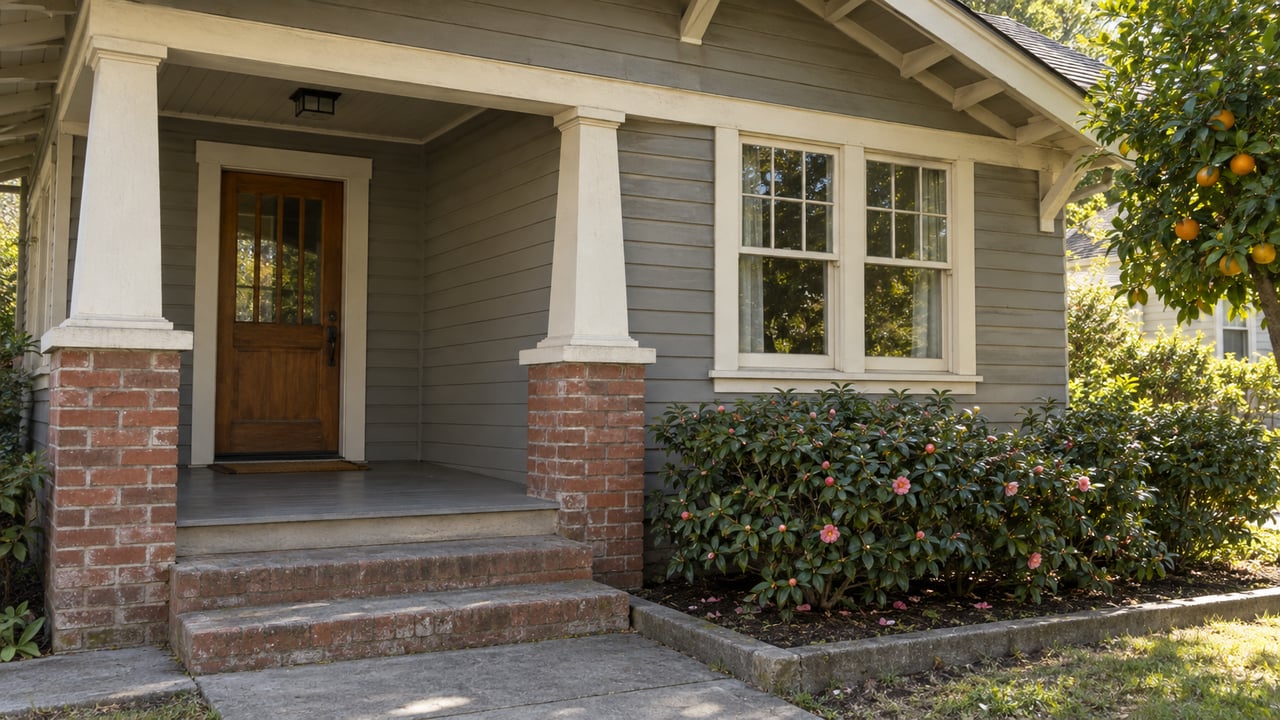
None of this is free money. Fullerton's own design guidelines are specific about permitted work on a historic bungalow. According to Fullerton Heritage's design guidelines, permitted facade materials are limited to brick, wood siding, cut stone, and stucco or plaster, and an existing wood facade cannot legally be covered over with stucco. The city's design guideline document uses a real case as its cautionary example, a remodeled Craftsman bungalow on the 100 block of North Cornell Avenue that failed to meet the standard because of vertical wood siding, incorrectly scaled porch posts, and replacement windows that did not match the original style.
Cosmetic interior work, the kind most buyers actually want to do first, generally does not count. City guidance is explicit that kitchen and bathroom renovations are not eligible expenditures under a Mills Act plan. What qualifies is exterior preservation and building systems, the unglamorous list: roofing, window repair, structural and mechanical work. The city also inspects contracted properties once every five years, with the owner required to be present, and at each ten-year renewal point the owner must file an updated rehabilitation and maintenance plan at least 90 days ahead of the deadline.
What transfers if you buy a home that already has one
If the home you are considering already carries a Mills Act contract, a few mechanics matter before you write an offer. According to the California Office of Historic Preservation, the contract is not tied to the current owner. It runs with the land, binding whoever buys the property next to the same maintenance obligations, inspection schedule. It also renews itself automatically each year, so most contracts simply keep accumulating years rather than expiring on any predictable date.
Breach carries real teeth. If an owner falls short of the contract terms or petitions to cancel early, Fullerton's guidelines call for a penalty equal to 12.5 percent of the property's assessed fair market value.
On the disclosure side, California's Transfer Disclosure Statement, required under Civil Code section 1102.2, obligates a seller of a one-to-four unit residential property to state whether the home is historically designated or sits within an existing or proposed historic district. The Mills Act contract itself transfers with the sale. If you are the buyer, ask for that document before you remove contingencies, not after.
Two more districts are moving through the process right now
Fullerton's list of eligible neighborhoods is not static. The Skyline Park neighborhood, a nine-block enclave of 114 lots from the late 1920s bounded roughly by Skyline Drive, Cannon Lane, North Lemon Street, and Sheppard Drive, held its community information meeting on March 19, 2025, as residents there weigh whether to petition for Residential Preservation Zone status. The Oceanview and Lower Golden Hill neighborhoods held a similar meeting on May 29, 2025, and signature gathering for their petition was underway shortly after, according to Fullerton Heritage's public updates. Separately, at least one recent listing in the city referenced a "newly-expanded Wilshire preservation zone," suggesting the boundaries of existing zones are still being adjusted as well.
If either petition succeeds, it would expand the preservation-zone discussion to another slice of Fullerton housing stock.
What to check before you make an offer
A few questions are worth asking before you fall for a listing photo of a barrel-tile roof or a Craftsman porch.
- Does the home carry a Historic Landmark number, sit in one of the 16 historic districts, or fall inside one of the 10 Preservation Zones? Fullerton's Planning Division, reachable through the city's Community and Economic Development Department, can confirm designation status on any specific address.
- If a Mills Act contract already exists, has the listing agent produced a copy of it, along with the current rehabilitation and maintenance schedule?
- If no contract exists yet, is the property otherwise eligible, and is applying worth the $1,520 processing fee and $85 annual fee given your renovation plans?
- Does your lender's appraiser have experience valuing historic-district comparables, since some conventional lenders ask for extra documentation on architecturally distinct properties?
Common questions about buying a Fullerton Mills Act home
Does a Mills Act contract end when the property sells? No. It stays with the land and binds the next owner to the same maintenance obligations and standards the original owner accepted.
Can I remodel a kitchen or bathroom if the home has a Mills Act contract? The tax savings are meant to fund exterior preservation and building systems work. City guidance specifically excludes cosmetic interior renovations like kitchen or bathroom remodels from qualifying expenditures.
What happens if a future owner lets the property fall out of compliance? Fullerton's guidelines allow for a penalty equal to 12.5 percent of the property's assessed fair market value if a contract is breached or canceled early.
Buying inside one of Fullerton's historic districts is as much a financial decision as an aesthetic one, and the paperwork rewards someone who reads it closely before closing. If you are weighing a listing in Skyline Park, Oceanview, Brookdale, or any of Fullerton's other designated neighborhoods and want a second set of eyes on what a Mills Act contract would actually mean for your monthly numbers, the Jin Hong Team can walk through the specific property with you before you write an offer.
This article is general information, not legal, tax or financial advice. Consult a qualified professional about your situation.